


Chiropractic care may be appropriate for some people with EDS, but treatment should be individualized and discussed with a healthcare provider first. The safety of chiropractic care for people with Ehlers-Danlos syndrome depends on the individual’s condition, EDS subtype, and proposed treatment.
Many people type chiropractic manipulation safety EDS into Google after a bad flare. Some read “totally safe.” Others read “never go.” The truth sits in the middle.
In Mequon, icy sidewalks, snow shoveling, and long I-43 drives already strain loose joints. Wright Chiropractic & Laser offers care for patients with EDS and hypermobility, using gentle techniques when appropriate. So, are you ready for your first visit? This guide shows you what to know, what to ask, and when to stop.
Key Takeaways
- Chiropractic care may be appropriate for some people with EDS when it’s gentle and low-force. Skip quick neck cracking and check with your doctor first.
- Treatment considerations vary by EDS subtype. Vascular EDS requires particular caution because of the risk of blood vessel and organ complications.
- Low-force techniques may place less mechanical stress on joints than high-velocity thrusts, but their safety and suitability should be assessed individually. Pair it with physical therapy to build joint strength.
- Talk to your doctor and bring your diagnosis and scans. Ask the chiropractor if they treat EDS and avoid forceful moves.
- Seek urgent medical evaluation for sudden dizziness, vision changes, a severe headache, or new numbness, particularly if these symptoms occur after treatment. A joint that slips out and won’t go back needs a doctor too.
- Chiropractic care may ease symptoms, but it cannot cure EDS, which is a genetic connective tissue disease.
When Is Chiropractic Safe for Ehlers-Danlos Syndrome?
It may be appropriate when your chiropractor knows EDS, uses low-force methods, and your doctor agrees. Ehlers-Danlos syndrome and chiropractic care can work together, but not in the usual way.
Standard chiropractic often uses quick twists. With conditions like EDS, the method matters more than the visit. People with Ehlers-Danlos syndrome need a softer plan built around their loose joints. Chiropractic care is more likely to be safe in these cases:
- Your chiropractor knows EDS. They ask about your type, loose joints, and past flares first. If your shoulder slips often, they won’t push it into a full stretch.
- The care uses light touch. Low-force techniques are intended to minimize mechanical stress on joints and surrounding tissues.
- Your doctor agrees. They know your heart, vessel, and neck history. Consult your healthcare provider before considering any cervical treatment, particularly if you have a history of neck instability or vascular complications.
- Your EDS subtype, vascular history, and any known cervical instability should be reviewed before treatment. Medical clearance may be particularly important in higher-risk cases.
- You can stop at any time. A good chiropractor lets you set the pace and changes the plan if a move feels wrong.
Care gets riskier when a provider rushes, cracks your neck, or skips questions about your EDS type.
Why Do EDS Joints Need Extra Care?
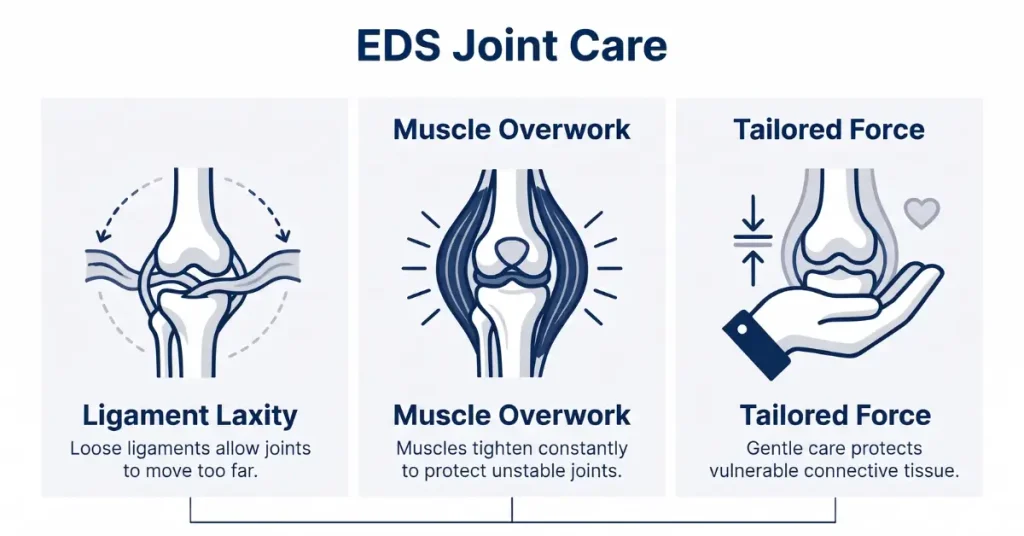
Loose ligaments let EDS joints move too far, so forceful moves can overstretch them. EDS is a group of genetic conditions. Doctors call them inherited connective tissue disorders. These are connective tissue disorders that affect skin, joints, and blood vessels. Here’s why that matters on a chiropractor’s table:
- Ligaments hold less. Due to ligament laxity, joints move too far and can slip out of place.
- Loose joints often hurt. That joint instability often brings chronic pain, neck pain, and low back pain.
- Muscles work overtime. They tighten to protect loose joints, which can add soreness after care.
- Joint stability and tissue health vary among individuals, so treatment force should be selected according to the patient’s clinical assessment.
- Hypermobile joints can overstretch. Forceful movements may place additional stress on already hypermobile joints and surrounding tissues.
Hypermobility spectrum disorder (HSD) causes similar loose-joint pain without meeting the criteria for EDS. People with hypermobility spectrum disorder may also require individualized care based on their symptoms and joint stability. Learn more about our hypermobility spectrum disorder treatments.
How EDS Affects the Nervous System and POTS
Some people with EDS also have POTS, a form of dysautonomia that affects the autonomic nervous system. Postural orthostatic tachycardia syndrome (POTS) is a form of dysautonomia that can cause an abnormal increase in heart rate when standing. Dysautonomia can affect how the autonomic nervous system regulates functions such as heart rate and blood pressure. Ask to sit up slowly after care, and report any dizziness or racing heart.
Why Proprioception Matters
Proprioception is your body’s sense of where each joint is, and it is often weaker with EDS. That makes it harder to feel when a joint moves too far. Slow, controlled movements may help patients remain aware of joint positioning during appropriate movement-based care.
What the Research Says
Most studies are small case reports of one or two Ehlers-Danlos syndrome patients. Few studies focus on patients with connective tissue disorders at all. If you search chiropractic manipulation safety EDS, that’s mainly what you’ll find. The NCCIH reports that mild side effects of spinal manipulation can include temporary soreness, stiffness, or discomfort. It also notes rare but serious problems after neck manipulation. Chiropractors may also use very different methods, so results vary.
Read the NCCIH guide to spinal manipulation.
The relationship between cervical manipulation and cervical artery dissection remains a subject of scientific discussion. However, the potential seriousness of these events warrants careful consideration of cervical manipulation risks. That uncertainty is one more reason to choose low-force care when you have fragile tissue.
Chiropractic Manipulation Safety: EDS Types Compared
Your EDS type changes the risk, and vascular EDS needs the most caution because of fragile vessels.
EDS has 13 recognized subtypes, and understanding your subtype is an important part of evaluating treatment considerations. A qualified healthcare professional with experience in EDS can evaluate your symptoms and determine whether genetic testing or other diagnostic assessments are appropriate. All 13 are genetic connective tissue disorders, but EDS affects each person differently.
| Type or condition | What It Means | Safety Level | What to Do |
| Hypermobile EDS (hEDS) | Very loose joints, the most common type | Treatment requires individualized assessment, with attention to joint instability and symptom response. | Use low-force chiropractic only |
| Classical EDS | Stretchy skin, loose joints, easy scarring | Use extra care | Avoid twists and deep pressure |
| Vascular EDS | Weak vessels and organs that can tear | Highest risk | Get your doctor’s okay first |
| Neck instability (CCI) | Loose upper neck joints | High risk for neck work | No cervical cracking at all |
Hypermobile Ehlers-Danlos syndrome has no gene test, so doctors use a checklist. How EDS presents can change over time. Some types of EDS also come with scoliosis, a curved spine. Learn more from MedlinePlus Genetics on Ehlers-Danlos syndrome.
Which Chiropractic Methods Use Less Force for EDS?
Low-force techniques may reduce the mechanical forces applied during treatment, but no technique should be described as universally safe for people with EDS. Traditional chiropractic care often uses high-velocity thrusts. People often ask, is HVLA safe for EDS? HVLA means high-velocity, low-amplitude, the quick “crack” move. High-velocity, low-amplitude (HVLA) techniques may be inappropriate for some people with EDS, particularly when joint instability or other risk factors are present.
| Lower-Force Options | Riskier Choices |
| Network Spinal Analysis | Fast, forceful twists |
| Instrument-assisted care | Neck cracking |
| Gentle soft tissue therapy | Deep stretching past your range |
| Postural corrective exercises | Heavy pressure on unstable joints |
How Is an EDS-Modified Adjustment Different From a Regular One?
An EDS-informed approach may involve modified techniques, reduced force, and careful attention to the patient’s range of motion and tolerance. The goal is to address discomfort while avoiding unnecessary stress on hypermobile or unstable joints.
| Feature | Regular Adjustment | EDS-Modified Approach |
| Speed | Fast, high-velocity thrust | Slow, steady pressure |
| Force | Moderate to firm | Light touch or a handheld instrument |
| Range | Moves the joint to its end range | Stays inside a comfortable range |
| Neck work | Rotation and quick thrusts are common | No twisting or thrusts |
| Pace | Several areas in one visit | One or two areas, with check-ins between |
| Main focus | Addressing movement restrictions or muscular tension | Calming muscle guarding and supporting stability |
Joint manipulation still helps many patients, but loose ligaments call for a lighter touch. With EDS, less is usually more.
Chiropractic Manipulation Safety: EDS and Your Neck
Cervical manipulation deserves particular caution in people with EDS, especially those with vascular involvement or known cervical instability. A Winnipeg health handout calls chiropractic neck manipulation contraindicated for people at higher risk of vertebral artery dissection because of joint hypermobility. Known cervical instability or vascular fragility may make cervical manipulation inappropriate and should prompt medical evaluation before any neck treatment. In plain words, if that risk applies to you, skip neck manipulation. See the WRHA EDS information handout.
Craniocervical instability (CCI) means the upper neck joints move too much. If you have neck pain with EDS, ask for gentle neck pain care in Mequon that skips rotation and thrusts.
Why Gentle Care Works Best With Physical Therapy
Gentle chiropractic care may ease tension, but it can’t build strength. Patients with hypermobile joints need strength around each joint. Physical therapy adds stabilization work for joint stability. Together, these approaches may help manage certain symptoms and support functional movement. You learn to move safely and effectively.
The Ehlers-Danlos Society recommends that physical therapy programs for people with EDS may include low-load exercises targeting stabilizing muscles. Postural corrective exercises can also ease strain from slouching.
How Chiropractic Fits With Your Other EDS Care
Chiropractic works best as one part of a team that may include your doctor, a rheumatologist, and a physical therapist. Your medical diagnosis and care plan come first. Share notes between providers, so everyone knows which joints slip and which moves to avoid.
What Should You Do Before Your First Adjustment?
Talk to your doctor, gather your records, and ask the chiropractor about EDS experience.
Searches for chiropractic risks hypermobility often share one worry: getting hurt on day one. A little prep keeps your first visit safe. Most chiropractic manipulation safety EDS advice comes back to one rule: go gentle.
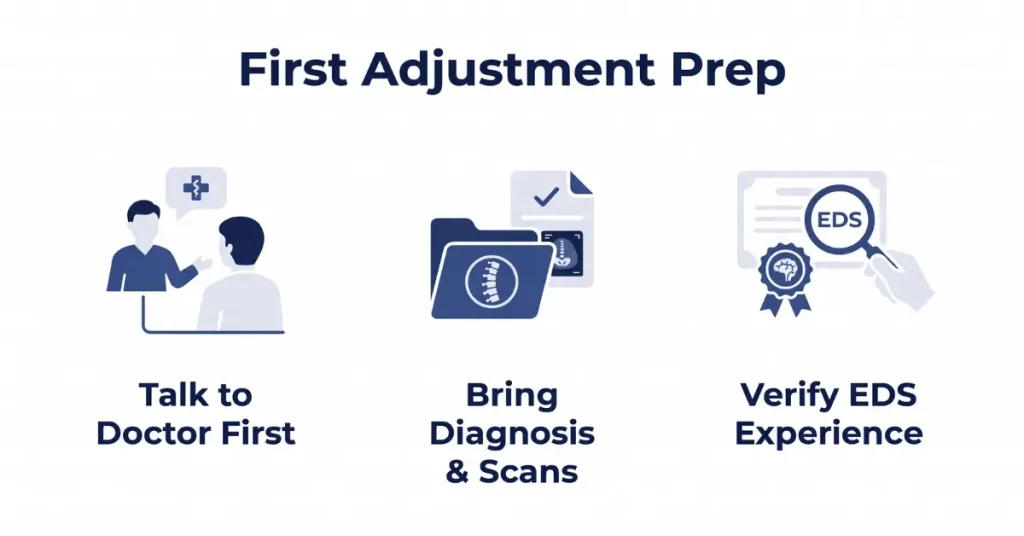
Talk to Your Doctor First
Discuss your treatment options with your healthcare provider before beginning hands-on care. This is particularly important if you have vascular EDS, known cervical instability, or other medical conditions that may affect treatment safety. Ask your doctor if seeking chiropractic care makes sense for you.
Bring Your Diagnosis and Scans
Patients with Ehlers-Danlos often have a long health history. Bring your diagnosis of EDS, past scans, and a list of joints that slip. This helps your chiropractor plan around your needs. You can also check what a new patient chiropractic evaluation costs before you book.
Questions to Ask an EDS-Aware Chiropractor
Ask how often they treat EDS, which low-force methods they use, and whether they skip neck cracking. Licensed chiropractors hold a Doctor of Chiropractic degree, but their clinical experience and additional training in EDS may vary. These questions help you judge the fit:
- How many hypermobile or EDS patients do you see each month?
- Which light-touch or instrument methods do you use?
- Will you avoid high-velocity thrusts and neck rotation?
- How will you change the plan if I flare after a visit?
- Do you work with physical therapists and medical doctors?
When Should You Not Get Adjusted by a Chiropractor?
Skip or delay an adjustment if you have a fresh dislocation, a possible fracture, new nerve symptoms, or vascular EDS without medical clearance. These are common reasons a chiropractor should pause hands-on care:
- A suspected or confirmed joint dislocation that has not been medically evaluated.
- A recent fall with a possible broken bone
- New numbness, weakness, or trouble walking
- Known upper neck instability without a plan from your doctor
- Vascular EDS without your doctor’s okay
- Known osteoporosis or significantly reduced bone density.
What Happens at Your First Visit at Wright Chiropractic & Laser?
Dr. Wright starts with your health history and a gentle exam, then begins with light care. Wright Chiropractic & Laser considers each patient’s EDS diagnosis, hypermobility, and individual treatment needs when developing a care plan.
Some patients with EDS may find that conventional chiropractic approaches do not provide lasting relief. That’s why the first visit moves slowly. Dr. Wright talks through chiropractic manipulation safety and EDS concerns before any hands-on care.
A Full Health History and Exam
Dr. Andrew Wright asks about your EDS type, past injuries, and which joints slip. He assesses your posture, spinal movement, and signs of generalized joint hypermobility. Some chiropractors talk about misalignment, but Dr. Wright focuses on how your joints move and feel.
Many providers screen loose joints with the nine-point Beighton score, which checks your thumbs, little fingers, elbows, knees, and spine.
A Slow, Gentle Start With Network Spinal Analysis
Network Spinal Analysis is a light-touch method Dr. Wright may use, with no cracking or twisting. Read how Network Spinal Analysis supports hypermobility.
Laser Care for Sore Spots
The handheld Horizon laser is used to target a specific treatment area. The Summus Laser Pod is designed to treat broader areas, such as the lower back. Both aim to support pain relief, but results vary.
Learn more about EDS treatment in Mequon.
When Should You Stop Care and Call a Doctor?
Stop treatment and seek medical evaluation if you experience dizziness, vision changes, a sudden severe headache, new numbness, or a suspected dislocation.
Chiropractic care may cause mild soreness. Individuals with EDS should watch for these signs, which need medical help:
- Dizziness or fainting
- Blurry or double vision
- A sudden, severe headache
- Numbness or weakness in an arm or leg
- A joint that slips out and won’t go back
- Trouble speaking or swallowing
Where Can You Find EDS-Aware Chiropractic Care Near Mequon?
Wright Chiropractic & Laser offers EDS-aware care at 1045 W Glen Oaks Ln, Ste 101, Mequon, WI 53092.
The office has a wheelchair-accessible entrance. Dr. Wright sees patients by appointment, so call or text first. Free on-site parking, a wheelchair-accessible parking lot, and an accessible restroom are available.
- Mornings: 9 to 11 AM, Monday to Friday
- Evenings: 3 to 6 PM, Monday, Wednesday, and Thursday
The practice serves patients from Thiensville, Cedarburg, Grafton, Bayside, Fox Point, and Whitefish Bay. Patients also visit from Milwaukee, Shorewood, Wauwatosa, Brookfield, and Menomonee Falls. See our EDS care options.
Chiropractic and EDS Safety FAQs
Can a Chiropractor Make EDS Worse?
Yes, it can happen. For some people with EDS, forceful moves can cause flares or a joint to slip. Modified, low-force techniques may reduce some treatment-related risks, but they do not eliminate the possibility of a flare or injury. Patients should be able to pause or stop treatment at any time. Tell your chiropractor about any soreness that lasts more than a day.
Is a Neck Adjustment Safe if I Have EDS?
Quick neck cracking is a poor fit for most people with EDS. Loose neck joints, and fragile vessels in vascular EDS, raise the risk. Ask for light-touch methods, and get your doctor’s okay before any neck work. Non-thrust approaches may be considered in some cases, but their suitability should be evaluated individually.
Does Insurance Cover Chiropractic Care for EDS?
Many plans cover chiropractic visits, but caps, copays, and exclusions vary. Call your insurer and ask our office about costs first. Read our guide to chiropractic insurance coverage for EDS.
How Often Should Someone With EDS See a Chiropractor?
It depends on your symptoms, your EDS type, and your goals. Some people start with more visits, then space them out. Your chiropractor should explain the plan and change it as you improve. Your chiropractor should monitor your response to treatment and adjust the frequency and duration of visits as appropriate.
Can Kids With EDS See a Chiropractor?
Yes, with a parent’s consent and a doctor’s okay. Children with EDS require an individualized treatment assessment that considers their age, symptoms, joint stability, and overall health. A parent can usually stay in the room and ask questions at each step. Care should match the child’s age, size, and comfort, and any move that hurts should stop right away.
Can Chiropractic Cure EDS?
No, chiropractic cannot cure EDS, because it is a genetic condition. Gentle care may help address muscle tension and support comfortable movement, although individual results vary. Lasting progress usually comes from a full plan that includes strength work, pacing, and support from your medical team.
Will Chiropractic Make My Joints More Unstable?
Gentle, low-force care is designed to avoid loosening joints, but forceful thrusts can overstretch lax ligaments. That is why EDS-aware chiropractors stay within your normal range. Physical therapy can help strengthen the muscles that support joint stability and function.
Is Chiropractic Safe for All Types of EDS?
No, safety depends on your type. Hypermobile EDS may respond to gentle care, while classical EDS needs extra caution with skin and joints. Vascular EDS has the highest risk because of fragile blood vessels, so get your doctor’s approval before any hands-on care.
Book a Gentle, EDS-Aware First Visit
Call or text 262-228-6198 to book a careful, low-force first visit. Questions about chiropractic manipulation safety EDS deserve an honest answer. Call Wright Chiropractic & Laser at 262-228-6198. Dr. Wright will build a gentle plan aimed at improving quality of life while living with Ehlers-Danlos syndrome. He will explain each step, answer your questions, and let you set the pace. Patients from Mequon, Thiensville, Cedarburg, and the North Shore are welcome. Ready for safe care that respects your loose joints? Schedule an appointment online today.