

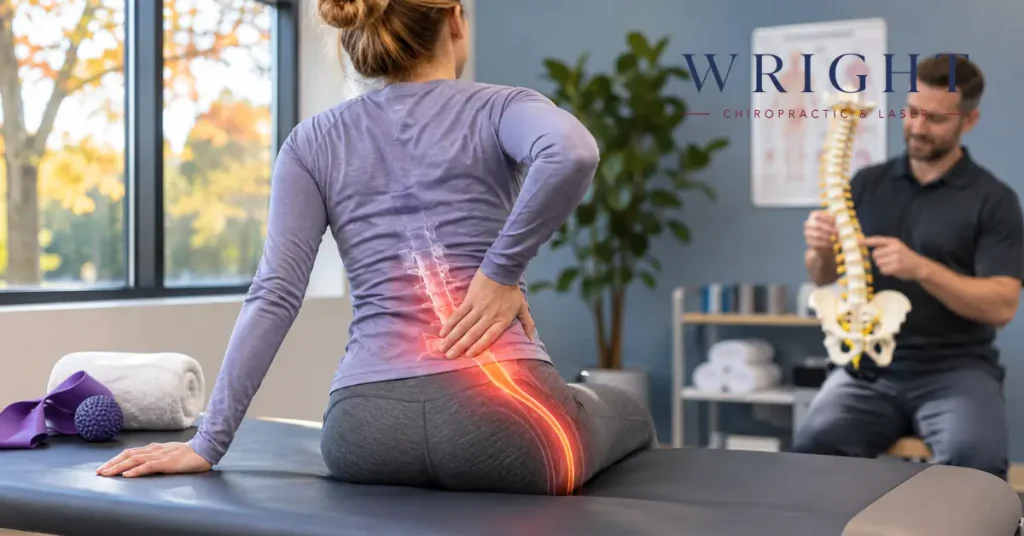
Not directly, but loose joints can irritate the sciatic nerve or cause pain that feels like sciatica.
Can hypermobility cause sciatica? People with joint hypermobility often ask this question. Many feel leg pain that runs from the buttock down to the foot. Mequon winters add icy sidewalks, heavy shoveling, and long I-43 drives to Milwaukee.
These activities can place additional stress on joints and surrounding tissues. Wright Chiropractic & Laser provides care for people with Ehlers-Danlos syndrome and hypermobility. So, is your leg pain real sciatica? This guide explains the causes, the warning signs, and safe care. It is written for people in Mequon, Thiensville, Cedarburg, and across Ozaukee County, Wisconsin.
Key Takeaways
- Hypermobility isn’t a proven direct cause of sciatica. Loose joints can still irritate the sciatic nerve or cause pain that feels like it.
- An unstable SI joint, spondylolisthesis, piriformis-related irritation, or a herniated disc may contribute to pain that resembles or involves sciatica.
- Real sciatica starts at a nerve in your back. Look-alikes start in a joint, a muscle, or the ankle.
- Get help fast for bladder or bowel changes, groin numbness, new leg weakness, fever, or a hard fall.
- Individualized, low-force care and appropriate strengthening may be considered instead of forceful spinal manipulation. People with vascular EDS should check with a doctor first.
- Wright Chiropractic & Laser in Mequon, WI 53092 starts with an exam, then uses low-force methods and laser care for hypermobile patients.
What Sciatica Really Means
Sciatica means pain, tingling, or numbness that travels along the sciatic nerve, from the lower back down one leg.
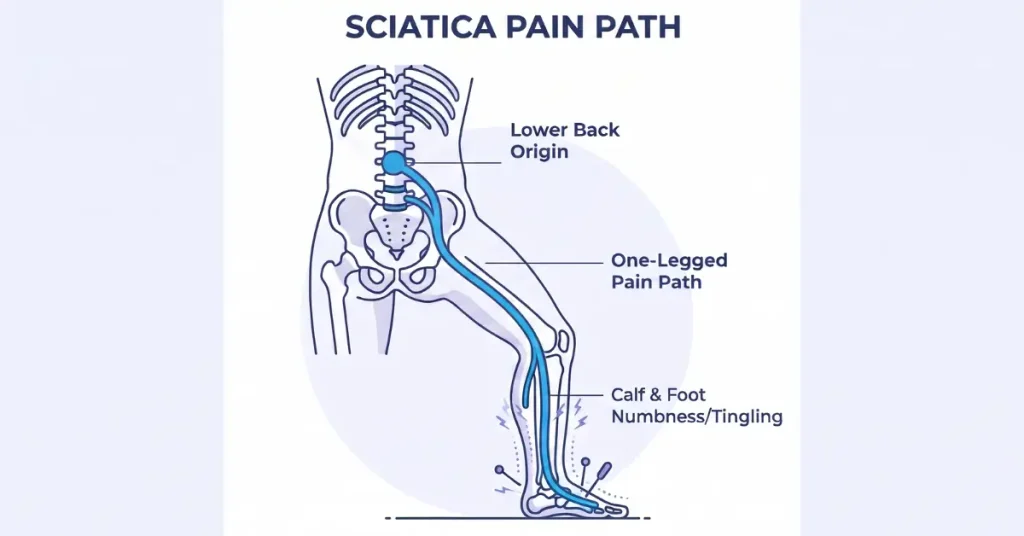
The sciatic nerve is the largest nerve in the body. This nerve extends from your lower back, through the buttock, and down each leg. Although sciatica is often described as a condition, it is a symptom of an underlying problem, like compression or irritation, affecting the sciatic nerve or its nerve roots.
The common symptoms of sciatica include:
- Sharp or burning pain along the back of one leg
- Numbness or a tingle in the calf or foot
- Muscle weakness in the leg
- Pain that gets worse with prolonged sitting, coughing, or sneezing
Sciatica typically affects one side of the body. According to MedlinePlus, it is most common among adults between the ages of 30 and 50. Read the MedlinePlus guide to sciatica.
What Can Cause Hypermobility Sciatica?
An unstable SI joint, spondylolisthesis, piriformis-related irritation, or a herniated disc may contribute to sciatica-like symptoms in some people with hypermobility.
Many people experience leg pain, yet their MRI comes back normal. Imaging does not always identify soft-tissue or functional problems that may contribute to pain. That’s why they search hypermobility and sciatica for answers. So, can hypermobility cause sciatica, or does it just feel that way? Your symptoms and the research both offer clues. In people with hypermobility, the underlying issue may sit in the pelvis or spine.
| Cause | How It Happens | What You Feel |
| Loose SI joint | Loose ligaments let the pelvic joint shift. | Buttock and upper thigh pain |
| Slipping vertebra | One bone slides forward and may compress a nerve root. | Sciatic pain down the leg |
| Tight piriformis muscle | Muscles guard loose joints and tighten. | Deep buttock ache and leg pain |
| Herniated disc | The soft center pushes out and puts pressure on the sciatic nerve. | Burning pain below the knee |
An Unstable SI Joint
The SI joint links your spine to your pelvis. Your sciatic nerve runs close to it. Changes in SI joint movement may contribute to lower back or buttock pain, although the relationship between SI joint dysfunction and sciatic nerve irritation requires careful assessment. You’ll often feel it on one side, just below your belt line. It may flare when you climb stairs or stand on one leg.
A small 2021 Dutch study looked at 16 Ehlers-Danlos syndrome patients with SI joint pain. Most were satisfied after SI joint fusion surgery, but three saw no improvement. It was a small retrospective case series without a control group, and it studied SI joint pain in EDS, not sciatica, so it does not prove that surgery helps everyone.
A Slipping Vertebra (Spondylolisthesis)
Here, one bone in the lower back slips over the one below. This slip can cause nerve compression, leading to sciatica. You may feel a dull back ache plus pain down one leg. Long walks or standing in line often make it worse. Some researchers have proposed a possible association between ligament laxity and spondylolisthesis, but evidence supporting this relationship remains limited.
Tight, Overworked Muscles Near the Nerve
With loose joints, muscles work overtime to hold you steady. The piriformis muscle lies near the sciatic nerve, which typically passes beneath it. In some cases, irritation or compression involving the piriformis muscle may contribute to buttock pain and symptoms that resemble sciatica. Say you sit through a long car ride on I-43. By the time you park, that tight buttock muscle may send pain down your leg.
Disc and Bone Problems
Sciatica is often caused by a herniated disc. Part of the disc bulges out and presses on a nearby nerve. In older adults, spinal stenosis or a bone spur can also squeeze the nerve. This pain can run past the knee, and bending forward may make it sharper. These problems can happen with or without loose joints.
Is It Real Sciatica or a Look-Alike?
Real sciatica starts at a nerve in your back, while look-alikes start in a joint, muscle, or ankle.
Not all leg pain is sciatica. In hypermobile people, a pelvic joint, a buttock muscle, or an ankle nerve can cause the same feeling. A thorough assessment tells them apart. Anyone asking if hypermobility can cause sciatica should start with this check, because each cause needs different care.
| If Your Pain | It May Be |
| Shoots below the knee and gets worse when you cough | Real sciatica |
| Stays around the hip and stops above the knee | SI joint pain |
| Feels like a deep knot in the buttock, mainly while sitting | A tight piriformis muscle |
| Burns or tingles only in the bottom of your foot | A squeezed nerve at the ankle, called tarsal tunnel syndrome |
Peripheral neuropathy, which is often linked to diabetes, can also cause burning, tingling, or numb feet. It usually affects both feet instead of one leg. Learn about neuropathy treatments in Mequon.
Only a provider can confirm the cause. Learn more about sciatica pain treatment in Mequon.
How Is Sciatica Diagnosed When You Have Hypermobility?
A provider evaluates possible sciatica using your medical history and a physical examination. They may also assess your joints for signs of hypermobility. Imaging is usually saved for severe, long-lasting, or red-flag pain.
Checking for Hypermobility
Providers often screen for generalized joint hypermobility with the nine-point Beighton score. It checks how far your thumbs, little fingers, elbows, knees, and spine bend. A high score alone does not diagnose EDS or hypermobility spectrum disorder (HSD), so your history matters too.
Tests for Sciatica
Most people do not need a scan right away. Your provider usually starts with simple in-office checks.
| Test | What It Checks | When It Is Used |
| Straight-leg raise test | Whether raising your straight leg reproduces your familiar radiating leg pain. | Most first exams |
| Strength, reflex, and sensation checks | How well the nerve sends signals to your leg and foot | Most first exams |
| Beighton score | How many joints bend past the usual range | When hypermobility is suspected |
| MRI or X-ray | MRI can help evaluate discs, nerve roots, and soft tissues, while X-rays can show vertebral alignment and certain bone changes. | Severe, long-lasting, or red-flag pain |
What Warning Signs Need a Doctor Right Away?
Seek urgent medical attention for new bladder or bowel dysfunction, numbness in the groin or saddle area, or new or worsening leg weakness.
These signs may indicate severe compression of the sciatic nerve or another serious underlying condition. One rare emergency, cauda equina syndrome, squeezes the nerve roots at the base of the spine. Seek immediate medical attention if you’re experiencing sciatica symptoms with:
- Loss of bowel or bladder control
- Numbness in the groin or inner thighs
- New weakness in the affected leg
- Fever with back pain
- Back pain after a bad fall, like on an icy driveway
- Persistent or unexplained night pain, particularly when accompanied by other concerning symptoms.
Severe nerve compression can cause permanent damage if not treated promptly. For emergency medical care, Ascension Columbia St. Mary’s Hospital Ozaukee provides 24-hour emergency services in Mequon.
People with vascular EDS have fragile blood vessels. Check with your doctor before any hands-on care. See the MedlinePlus guide to Ehlers-Danlos syndrome.
What Makes Sciatica Worse for Hypermobile People in Mequon?
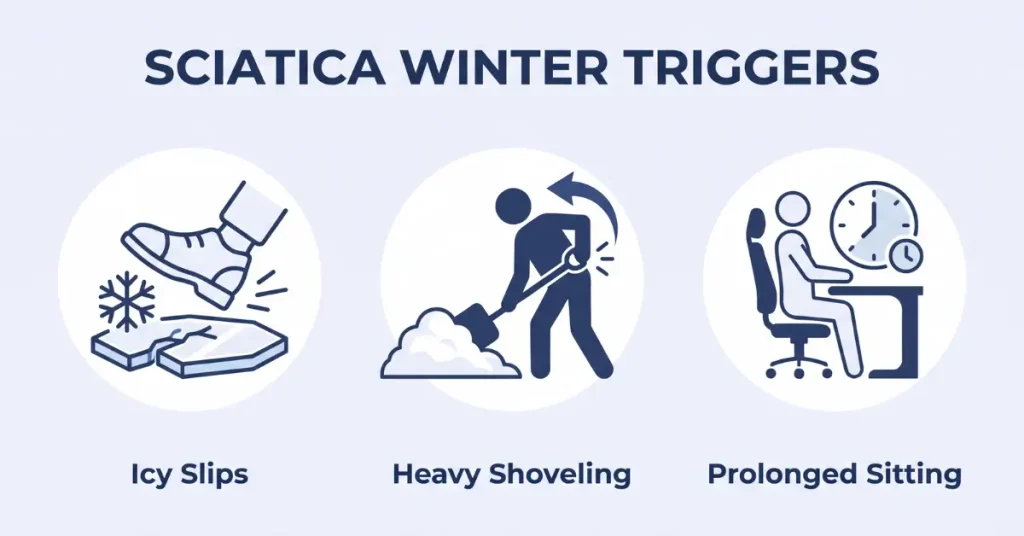
Icy falls, cold muscles, heavy snow shoveling, and long sitting can all make sciatica worse in Mequon.
Individuals experiencing loose-joint pain may notice more flare-ups in winter. Cold-weather habits may affect your sciatica symptoms and raise your risk of developing new pain.
Icy Sidewalks and Winter Falls
One slip near your mailbox can jolt a loose SI joint. Wear shoes with good grip, and salt your steps early.
Cold Muscles and Snow Shoveling
Cold weather may make some people feel stiffer or less comfortable. Lifting heavy, wet snow while twisting may aggravate existing back or leg pain. Push snow to the side instead of lifting it.
Long Hours at a Desk or on I-43
Sitting puts steady pressure on the buttock and lower back. Get up and walk every 30 minutes, at work and during other daily activities. See how we approach hypermobility treatment in Mequon.
Other Risk Factors for Sciatica
Age, extra body weight, a desk job, and diabetes can also raise your risk. Age-related disc wear and narrowing of the spinal canal are more common in older adults. A job with long sitting or heavy lifting adds steady strain to the lower back.
What Care Is Safe for Hypermobility and Sciatica?
Gentle, low-force care plus steady strengthening is safer than quick, forceful twists. People who ask this usually want to know what care is safe next. Sciatica hypermobility cases need a careful treatment plan. If you’re experiencing sciatica, start gently.
| Lower-Force Options | Riskier Choices |
| Low-force chiropractic care | Quick, forceful cracking |
| Physical therapy for strength | Deep stretching past your range |
| Gentle manual therapy | Heavy lifting too soon |
| Short walks and ice or heat | Long bed rest |
Why Forceful Twists Can Backfire
Hypermobility can involve an increased range of joint movement. Forceful manipulation may place additional stress on some joints and surrounding tissues.
How Physical Therapy Can Help Manage Symptoms
Physical therapy, also called physiotherapy, helps by training the muscles that hold loose joints steady. Reduced muscle strength or control may affect joint stability and movement. A physical therapist uses exercises designed for stability. They train your muscles to switch on at the right time. That muscle activation helps improve joint control. Over time, an individualized exercise program may help improve strength, movement control, and functional ability.
NINDS says low-impact exercises can strengthen the back and belly muscles. Read the NINDS back pain guide.
What Is the Quickest Safe Way to Relieve Sciatica at Home?
Some people find temporary relief through ice or heat, gentle walking, and brief rest periods rather than prolonged bed rest. Ice or heat may provide temporary relief, depending on individual comfort and symptoms. Over-the-counter medication, such as ibuprofen or acetaminophen, may also help if your doctor says it is safe for you.
- Walk for a few minutes every hour instead of staying in bed.
- Avoid activities that significantly aggravate your symptoms, and ask your healthcare provider when it is appropriate to resume heavy lifting or twisting.
- Sleep on your side with a pillow between your knees to keep your pelvis level.
- Stop any stretch that pushes a loose joint past its normal range.
How Does Wright Chiropractic & Laser Help Hypermobile Patients With Leg Pain?
Dr. Wright starts with a careful exam, then uses gentle Network Spinal Analysis and laser care.
Wright Chiropractic & Laser focuses on EDS, hEDS, and hypermobility spectrum disorder. Dr. Andrew Wright knows that EDS and sciatica can overlap. When patients ask, “Can hypermobility cause sciatica?” he starts with an exam, not a guess.
A Careful Exam for Loose Joints
Dr. Wright checks your musculoskeletal health, including joint looseness, posture, and range of motion. He asks where you’re experiencing pain, then checks the affected area and along the nerve pathway. If your symptoms require evaluation by another healthcare professional, he can recommend an appropriate referral.
Gentle Network Spinal Analysis
This chiropractic method uses light touch instead of twists. Your chiropractor places gentle contacts at set spinal points. The intended goal is to support comfort and movement.
Horizon and Summus Laser Care
The handheld Horizon laser targets one sore spot. The Summus Laser Pod covers wider areas. Both devices are used as part of the practice’s laser therapy services. Research on laser therapy for sciatica and nerve-related pain is limited, and individual results vary.
Learn more about EDS treatment in Mequon.
Where Can You Get Hypermobility Sciatica Care Near Mequon, WI?
You can get gentle, hypermobility-informed sciatica care at 1045 W Glen Oaks Ln Ste 101, Mequon, WI 53092. Wright Chiropractic & Laser serves Thiensville, Cedarburg, Grafton, and Milwaukee’s North Shore, including Bayside, Fox Point, Whitefish Bay, and Shorewood.
Office hours are Monday, Wednesday, and Thursday from 9:00 to 11:00 AM and 3:00 to 6:00 PM, and Tuesday and Friday from 9:00 to 11:00 AM. Appointments are required. The office has free on-site parking and a wheelchair-accessible entrance, parking lot, and restroom.
Can Hypermobility Cause Sciatica? FAQs
Can Hypermobility Cause Sciatica on Its Own?
No, hypermobility does not cause sciatica by itself. Loose ligaments can let the SI joint shift, a vertebra slip, or muscles tighten around the sciatic nerve. Those changes can irritate the nerve or create pain that feels like sciatica, so an exam helps find the real source.
Can EDS Cause Nerve Pain?
It may. Loose joints and tight muscles can press on nerves in the leg or foot. Some people with EDS also notice tingling, burning, or numb spots. Tell your provider when the pain started, which side it affects, and what makes it worse, so the cause is easier to find.
Can Sciatica Go Away on Its Own?
Often, yes. MedlinePlus says sciatica may ease without treatment, but it often returns. Underlying joint, muscle, or spinal problems may contribute to recurring symptoms, particularly when activities aggravate the affected area. Steady strengthening may lower the chance of repeat episodes. See a provider if pain lasts more than four weeks.
Is Chiropractic Care Safe if I Have EDS?
Chiropractic care is not appropriate for everyone with EDS. Treatment decisions should be based on the individual’s EDS subtype, symptoms, joint stability, and medical history. Ask your chiropractor to skip quick, forceful twists. People with vascular EDS should consult their specialist before considering hands-on treatment because of the risks associated with vascular fragility. Read how Network Spinal Analysis supports hypermobility, then bring your diagnosis and past scans to your first visit.
What Exercises Help Hypermobility and Sciatica?
Start with gentle moves like belly-tightening holds, hip bridges, and short walks. These may help you manage pain. Stop any move that sends pain down your leg. A physical therapist can choose the right number of reps and hold times for your joints.
Do I Need an MRI for Sciatica?
Not always. Doctors often skip tests unless the pain is severe or long-lasting, says MedlinePlus. An MRI may help with red-flag signs, leg weakness, or pain that does not improve. A normal scan does not necessarily rule out all causes of buttock or leg pain, including certain soft-tissue or functional problems.
Can Sciatica Make Your Feet Tingle?
Yes, sciatica can cause tingling, pins and needles, or numbness in the calf, foot, or toes. Doctors call tingling paresthesia and numbness hypoesthesia. If only the bottom of your foot burns, an ankle nerve may be involved instead. New numbness with leg weakness needs a prompt exam.
Get Gentle Care for Hypermobility and Sciatica
Call or text 262-228-6198 to schedule an evaluation. So, can hypermobility cause sciatica? Not by itself, but loose joints can play a part. Call Wright Chiropractic & Laser at 262-228-6198. Dr. Wright can discuss appropriate care options to help manage your symptoms and support your return to daily activities. Patients from Mequon, Thiensville, Cedarburg, and across Ozaukee County are welcome at the office on W Glen Oaks Ln. Ready to feel steadier and move with confidence? Schedule an appointment online today.