


It uses light, low-force touch at set spine points, not the quick twist or crack of a standard adjustment.
If you have hypermobility, the word chiropractor may make you nervous. Many people with loose joints worry about twisting and cracking. So how does Network Spinal Analysis for hypermobility work? This guide explains each step, the limits, and what to ask. At Wright Chiropractic & Laser, we see patients with Ehlers-Danlos syndrome (EDS) and Hypermobility Spectrum Disorder (HSD) from Mequon, Cedarburg, and Thiensville.
Quick Answers
- NSA uses gentle contacts at specific points along the spine. These contacts are not forceful adjustments.
- A visit has four steps: health history, light contact, rest, and a quick check.
- Safety depends on your EDS or HSD type and health history. Talk with your medical doctor before any neck work.
- Dr. Andrew Wright sets your visit count and spacing after your exam. We list no price online, so call +1 262-228-6198 for cost.
- We can pair NSA with the Summus Laser Pod or the Horizon handheld laser when your exam supports it.
- Call +1 262-228-6198 to ask about steps, safety, cost, and your first visit.
What Is Network Spinal Analysis?
It is a gentle chiropractic method that uses light touch along the spine.
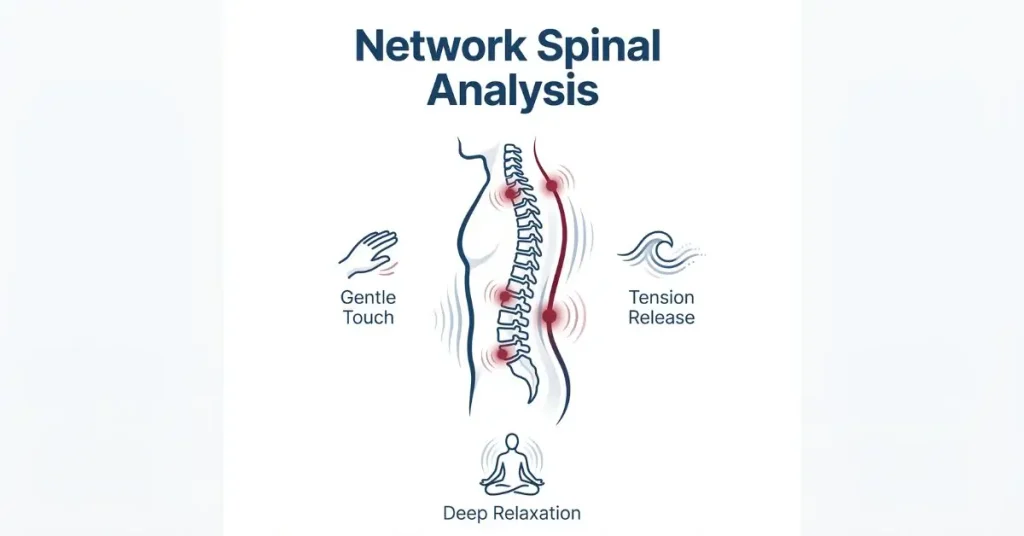
On our Network Spinal Analysis page, we describe the method as using gentle contacts at specific points along the spine. These contacts are not forceful adjustments. The method was developed by Dr. Donald Epstein. The aim is to support how your body handles tension and movement.
What the Method Is
Network Spinal Analysis, or NSA, is a form of chiropractic care. You may also see it called Network Spinal Care or Network Chiropractic. It does not use spinal manipulation with a quick thrust. Think of a soft, steady touch instead.
What the Touch Feels Like
Patients often describe the experience as relaxing and comfortable. Your own feelings may differ. Ask us what to expect.
How Does Network Spinal Analysis for Hypermobility Work Step by Step?
A visit has four steps: history, light contact, rest, and a quick check.
We set the exact order at your exam, so use this as a map. Here is how the NSA may look in the room.
Step 1: Check-In and Health History
You share your story, scans, and medicines. Name your EDS type and any past dislocations. Dr. Wright builds your care plan from this.
Step 2: Light Touch at Set Spine Points
Dr. Wright places light contacts along your spine. We aim to support communication within your nervous system. Research on this idea is still developing, so treat it as a goal, not a promise.
Step 3: How Your Body Responds
Many patients rest quietly here. You may relax, or you may notice nothing. Tell the team how you feel.
Step 4: A Quick Check Before You Leave
The team checks in before you go. You can ask about your next visit and what to watch for at home.
Why Does Hypermobility Change the Care?
Loose ligaments let joints move too far, so force can strain them.
Hypermobility means a joint moves past the normal range. Many clinicians screen for it with the Beighton score, a quick check of joint range. The MedlinePlus page on Ehlers-Danlos syndrome explains how connective tissue changes in Ehlers-Danlos syndromes. Hypermobile EDS (hEDS) is the most common type. According to The Ehlers-Danlos Society, HSD describes joints that move beyond the typical range and become unstable and painful without meeting the criteria for EDS.
Loose Ligaments and Joint Instability
Ligaments hold joints in place. In EDS, collagen works differently, so ligaments hold less. That raises pain and joint instability. A loose hinge on a door is a fair picture.
Why Hard Force Can Hurt
A quick twist can push a loose joint too far. Say your cervical spine feels unstable (sometimes called cervical or craniocervical instability). A hard turn there adds strain.
Why Low Force May Suit Loose Joints
Light touch gives a joint very little push. That may lower the chance of strain. For that reason, gentle chiropractic care is one option many people with EDS ask about. Whether it fits you depends on your type and history.
How Is It Different From a Standard Adjustment?
It uses light touch, not a quick twist or crack.
A chiropractic adjustment often pushes a joint to its end range. That push can strain loose ligaments. NSA does not use that kind of push, and the touch stays light.
Force, Speed, and Feel
| Network Spinal Analysis | Standard adjustment | |
|---|---|---|
| Force | Light | Often firm |
| Speed | Slow and steady | Quick |
| Feel | Calm touch | Sometimes a pop |
| Strain risk for loose joints | Aims to be lower | Can be higher |
No method removes all risk. Share your history either way.
What Does a Visit Feel Like?
Many patients describe light touch and calm, but ask the office what to expect.
Two people on the same table can feel different things. Sore spots, stress, and sleep all play a part.
During Your Visit
You may feel a soft touch on your back or neck. Speak up at once if anything hurts.
After Your Visit
Some people feel loose or sleepy. Others feel sore, or notice no change. Track your back pain or neck pain for a few days.
When to Call the Office
Call if pain grows, numbness spreads, or a joint slips out. Get urgent care for sudden, severe symptoms.
Is Network Spinal Analysis Safe for EDS and HSD?
It aims to be gentler on loose joints, but safety depends on your EDS type and health history.
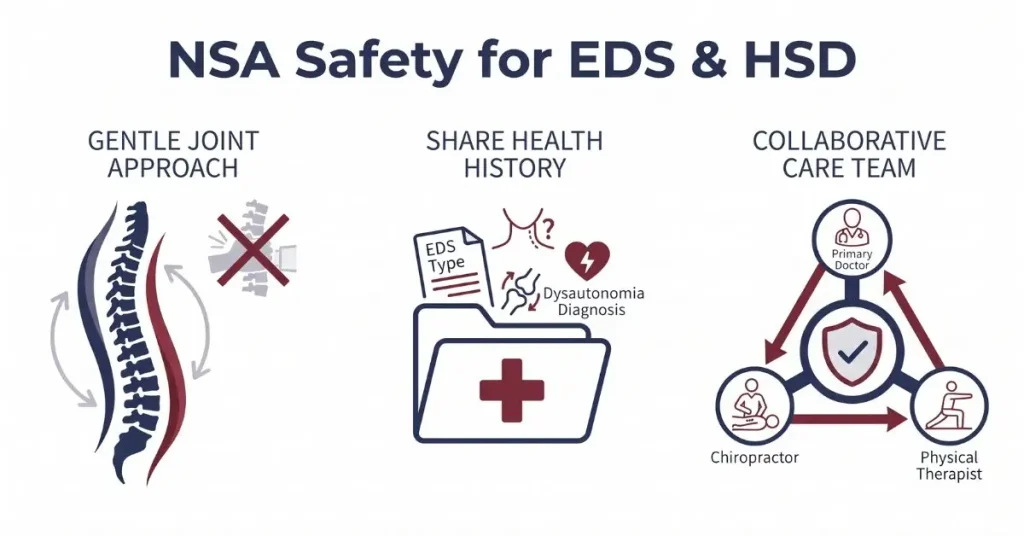
A doctor may have told you chiropractic is off limits. That advice is often aimed at forceful spinal manipulation. Whether NSA fits you is a decision to make with your medical team and Dr. Wright.
Tell the Team Your EDS Type
Share these before your first visit:
- Your EDS or HSD type
- Past dislocations or sprains
- Neck, jaw, or blood vessel concerns
- Medicines and recent scans
- Dizziness, fainting, or a POTS or dysautonomia diagnosis
Neck and Blood Vessel Caution
Some EDS types affect blood vessels. Vascular EDS (vEDS) is one example. Talk to your medical doctor before any neck work. Your primary care doctor and your chiropractor can share your care. A physical therapist who knows hypermobility can also be part of that team.
What It Cannot Promise
It cannot cure EDS or HSD. It aims to support comfort and movement. Some people question the evidence behind parts of chiropractic, so ask us which studies we rely on.
Who Provides Your Care?
Dr. Andrew Wright is a licensed chiropractor in Mequon and a Milwaukee native. He earned his Doctor of Chiropractic at Life University. He also holds a Bachelor of Science in Natural Resource Management from Cornell University. Chiropractic physicians, also called DCs, finish chiropractic education and pass National Board of Chiropractic Examiners tests.
What Can Patients Expect Over Time?
Dr. Wright sets visit count and spacing after your exam.
We list no set number of visits, because plans are individualized and results vary.
Visit Count and Spacing
Ask how many visits Dr. Wright expects and how far apart they run. A clear count helps you plan your week.
Honest Limits of Network Spinal Analysis for Hypermobility
Researchers still test NSA, and results differ by person. So set small goals, like fewer flare days.
How Does It Fit With Laser Care?
Dr. Wright may pair it with the Summus Laser Pod or the Horizon handheld laser.
At Wright Chiropractic & Laser, the team can mix gentle touch with laser care. Your exam, not a template, shapes the mix. Two patients with back pain may get two different plans.
With the Laser Pod
The pod is a whole-body laser that aims to support healing. Dr. Wright may add it for widespread pain.
With the Horizon Laser
The handheld laser targets one sore spot, like a shoulder. It suits a single trouble area.
What Does It Cost, and Does Insurance Pay?
We list no price online, so call before you book.
Fees can differ by visit and method. One call to +1 262-228-6198 clears that up.
What Many Plans Do
Many health plans cover chiropractic care but may skip special methods or laser. Insurance coverage rules differ, so check yours.
Questions to Ask Before You Book
| Ask this | Why it matters |
|---|---|
| What does one visit cost? | You see the full number |
| Does the fee include NSA? | Methods may bill apart |
| How many visits will I need? | You can budget ahead |
| Do you take my plan? | Plans differ |
Can You Get Care Through Wisconsin Seasons?
Care happens indoors and uses light touch, so Mequon weather rarely changes your plan, though severe storms can make travel unsafe.
Mequon winters bring snow, ice, and wind off Lake Michigan. The National Weather Service Milwaukee/Sullivan office posts winter updates. Check them before you travel.
Cold Months and Stiff Joints
Cold mornings can leave your back, hips, and knees stiff. Light touch asks little of tight soft tissue, so winter does not rule it out.
Ice, Snow, and Fall Risk
An icy step can strain loose joints. Shoveling can too, so take short turns. Leave extra time on W Mequon Rd. If snow or ice makes travel unsafe, call +1 262-228-6198 before you leave to ask about your appointment.
Spring and Summer Activity
Warm days send people to Mequon Nature Preserve and Mee-Kwon Park. A fast start can strain hypermobile joints. Go slow after winter.
Easy Access Year-Round
The office has a wheelchair-accessible entrance, restroom, and parking.
What Can Steady Care Aim to Support?
Steady care aims to support movement, give you a clear plan, and track progress.
The National Center for Complementary and Integrative Health tells you to talk with your providers about chronic pain. At Wright Chiropractic & Laser, that talk starts at your exam.
A Clear Plan Instead of Guesswork
Your exam shows what to treat first. Then you know what to expect and what it costs.
Support for Daily Movement
The plan aims to support how you move, stand, and sleep. We cannot promise pain relief, but we aim to support comfort and function.
Progress Checks Along the Way
Share changes in your overall health each visit. Small notes help the team adjust your plan.
Where Do You Find Care Near Mequon?
The office is in Mequon, close to Thiensville and Cedarburg.
Wright Chiropractic & Laser serves Ozaukee County and nearby towns. W Mequon Rd, Green Bay Road, and I-43 link them.
Where the Office Sits
The address is 1045 W Glen Oaks Ln, Suite 101, Mequon, WI 53092.
Visit Us at a Glance
| Business | Wright Chiropractic & Laser, a women-owned chiropractic practice |
| Address | 1045 W Glen Oaks Ln, Suite 101, Mequon, WI 53092 |
| Phone and text | +1 262-228-6198 |
| Hours | Monday: 9:00 AM to 11:00 AM and 3:00 PM to 6:00 PM. Tuesday: 9:00 AM to 11:00 AM. Wednesday: 9:00 AM to 11:00 AM and 3:00 PM to 6:00 PM. Thursday: 9:00 AM to 11:00 AM and 3:00 PM to 6:00 PM. Friday: 9:00 AM to 11:00 AM. Saturday and Sunday: closed. |
| Booking | Appointment required. Call +1 262-228-6198 or use the contact page. |
| Accessibility | Wheelchair accessible entrance, parking lot, and restroom |
| Parking | Free on-site parking lot |
| Payments | Credit and debit cards (Visa, Mastercard, Discover, American Express) and checks. |
Towns Nearby
| Area | Towns |
|---|---|
| Ozaukee County | Mequon, Thiensville, Cedarburg, Grafton |
| North Shore | Bayside, Fox Point, Whitefish Bay, Shorewood |
| Greater Milwaukee | Milwaukee, Wauwatosa, Brookfield, Menomonee Falls |
FAQs
Is Network Spinal Analysis Safe for EDS?
It aims to be gentle, but safety depends on your EDS type. Share your history and talk to your doctor before any neck work.
Does Network Spinal Analysis Hurt?
We describe the touch as gentle and comfortable. Tell the team right away if anything hurts, and ask what to expect first.
Is Network Spinal Analysis Like a Regular Adjustment?
No. A standard adjustment often uses a quick push. Network Spinal Analysis uses light, steady touch at set spine points.
How Many Visits Do You Need?
We list no set count. Dr. Wright plans visits after your exam, so ask how many he expects and how far apart.
Does Insurance Cover Network Spinal Analysis?
Plans differ. Many cover chiropractic visits but may skip special methods. Call +1 262-228-6198 and your insurer to confirm coverage first.
How Do I Book Network Spinal Analysis in Mequon?
Call +1 262-228-6198 or use the contact page. Bring your scans, medicine list, and questions, and ask about cost and visit length.
Is Network Spinal Analysis the Same as Network Spinal Care?
Yes. Network Spinal Analysis is also called Network Spinal Care or Network Chiropractic. The names describe the same gentle approach, which uses light contacts at specific points along the spine instead of a quick thrust. Ask Dr. Wright how he applies it for hypermobility at your exam.
Can I Try Network Spinal Analysis if a Doctor Told Me to Avoid Chiropractic?
Possibly, but check first. That warning is often aimed at forceful spinal manipulation, while Network Spinal Analysis uses light touch. Share the advice with Dr. Wright, bring your records, and confirm with your medical doctor, especially if you have neck instability or vascular EDS.
What Is the Difference Between hEDS and HSD?
Hypermobile EDS (hEDS) is a type of Ehlers-Danlos syndrome with its own diagnostic criteria. HSD is considered when joints are hypermobile and cause symptoms but do not meet the criteria for any type of EDS. Both can bring joint instability and pain, so tell us your diagnosis.
Call to Book Network Spinal Analysis for Hypermobility
If you’re considering Network Spinal Analysis for hypermobility, Wright Chiropractic & Laser can help you explore your options. Call +1 262-228-6198 to ask about costs, visit length, and care for your EDS or HSD type. Dr. Andrew Wright reviews your history, explains each step, and adjusts care to your needs. Network Spinal Analysis is not a cure, and referrals may be recommended when appropriate. Patients from Mequon, Thiensville, Cedarburg, Grafton, and the North Shore are welcome.
Ready to learn more? Schedule online or call or text to book your first visit.